The UDL Principle of Representation and how perception occurs
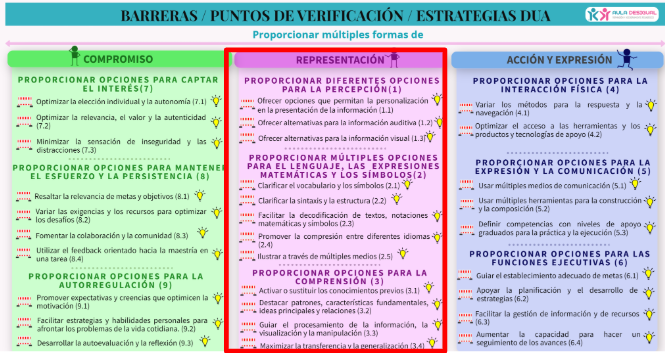
Principle of Representation
The Principle of Representation is based on presenting information through diverse media and formats, considering the different ways students access, perceive, and process information. This allows each student to choose or prioritize the format that best suits their needs, ensuring that all learners are included.
In this module, we will explore digital tools and resources that facilitate the representation of information and help reduce barriers. Referring to the image on the left, we will focus on the Principle of Representation, located in the center. However, we will primarily concentrate on guideline 1, related to perception, while also covering some aspects of guideline 2, related to language, and guideline 3, related to comprehension.
Perception
For students to build their learning, process information, assign meaning to it, and eventually internalize it, the first step is access to that information, which occurs through perception—a process that varies for each student.
Understanding access to information is really important and requires considering how the brain processes stimuli, transforming them into meaningful and comprehensible information. This process is known as perception. But what are perceptual processes? To better understand them, it is necessary to first analyze how different basic cognitive processes unfold. This will provide a foundation for better understanding the role of perceptual processes in learning:
Human perception and memory process
.png "HOW DOES PERCEPTION OCCUR_ - visual selection")