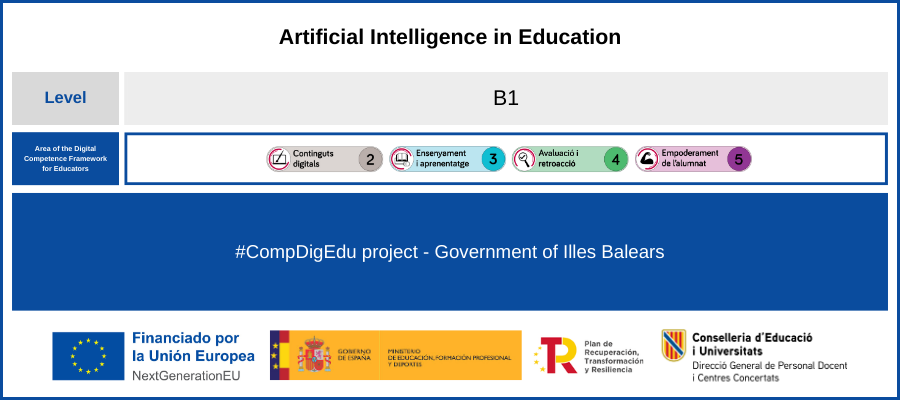
Artificial Intelligence in Education_Presentation
Training Details
Strategic line
LE2 Digital Competence and Emerging Technologies.
Competencies and Indicators
- Area 2. Digital Resources. Level B1
- 2.2 Creation and modification of digital content.
- 2.2.B1.1 Analyzes the suitability of existing digital educational content and autonomously applies didactic, disciplinary, and technical criteria to adapt it to a specific learning situation.
- 2.2.B1.3 Uses authoring tools to edit digital educational content and replaces or modifies some of its elements, including metadata.
- 2.2 Creation and modification of digital content.
- Area 3. Teaching and Learning. Level B1
- 3.1 Teaching
- 3.1.B1.1 Selectively integrates the digital resources available at the school into didactic planning, following the pedagogical model outlined in the educational project (PE).
- 3.1.B1.2 Uses the available digital resources at the school in a conventional and autonomous manner, selecting them based on their characteristics, the educational context, and the teaching modality (face-to-face, online, remote, hybrid, or blended).
- 3.1.B1.3 Assesses, during use, the suitability of the digital resources regularly employed to help students achieve learning objectives.
- 3.2 Learning guidance and support
- 3.2.B1.1 Interacts with students autonomously and in a manner adjusted to their characteristics and educational situation to provide support and guidance during learning through digital technologies provided by the Educational Administration (AE) or the school authorities.
- 3.2.B1.2 Uses the school's digital technologies to obtain immediate feedback on student activity and the difficulties encountered during the learning process, enabling timely intervention when necessary.
- 3.2.B1.3 Establishes a systematic procedure for incorporating digital technologies appropriately to student characteristics to help overcome difficulties in acquiring specific learning.
- 3.4 Self-regulated learning
- 3.4.B1.1 Implements, in the classroom and autonomously, tasks adapted to the students’ developmental stage that allow them to plan, document, record, and review their learning using digital technologies..
- 3.1 Teaching
- Area 4. Assessment. Level B1
- 4.1 Assessment strategies
- 4.1.B1.2 Diversifies techniques, media, and assessment tools for student learning and teaching practice, using the school’s digital technologies autonomously.
- 4.2 Learning analytics and Evidence
- 4.2.B1.1 Uses digital technologies provided by the AE or school authorities to obtain, import/export, store, process, visualize, and interpret data related to the assessment of the teaching-learning process.
- 4.1 Assessment strategies
- Area 5. Empowering Learners. Level B1
- 5.1 Accessibility and inclusion
- 5.1.B1.1 Independently uses the accessibility options of the school’s technology, selecting those most appropriate for students.
- 5.2 Addressing individual learning differences
- 5.2.B1.1 Uses the digital resources available at the school to incorporate them selectively and inclusively into didactic planning.
- 5.2.B1.2 Identifies the parameters and pedagogical models associated with digital technologies provided by the AE or school authorities to offer personalized learning responses and understands the role of artificial intelligence in providing such responses.
- 5.3 Active student engagement in their own learning
- 5.3.B1.2 Implements pedagogical strategies based on the usability and accessibility conditions of the school’s digital technologies, enabling students to progressively use them autonomously in different learning processes.
- 5.3.B1.3 Independently uses digital resources provided by the AE or school authorities that stimulate motivation and student engagement in learning.
- 5.1 Accessibility and inclusion
Objectives
- Understand how AI works, its limitations, benefits, and risks.
- Reflect on the ethical use of AI and the changes it brings to education.
- Learn how to create effective educational prompts.
- Learn to use various AI tools and applications to create diverse teaching materials (images, videos, music, mind maps, presentations, etc.), design learning situations and lesson plans, facilitate assessment processes (create rubrics and exam questions, provide feedback, and analyze data), and enhance diversity inclusion and personalized learning.
Contents
-
Module 1. Introduction to AI: What generative AI is, how it works, its potential in education, risks and mitigation measures, chatbot comparison, ethical considerations, and regulations.
-
Module 2. Communication with AI (Prompting): How to create effective educational prompts (instructions) and a prompt library.
-
Module 3. AI for Educational Content Creation: Strategies and tools for creating images, videos, music, mind maps, and presentations.
-
Module 4. Planning and Designing Teaching Tasks: Strategies and tools for designing learning situations and classroom sessions.
-
Module 5. AI as an Assessment Assistant: Strategies and tools for creating rubrics and exam questions, providing feedback, and analyzing data.
-
Module 6. Personalized Learning and Diversity Inclusion: Strategies and tools to support neurodiversity and personalize learning experiences.
-
Module 7. The Future of Education: Discussion on the evolution of essential 21st-century skills, the impact of AI on educational expectations, and how teaching and assessment methods should adapt.
Llicenciat sota la Llicència Creative Commons Reconeixement CompartirIgual 4.0